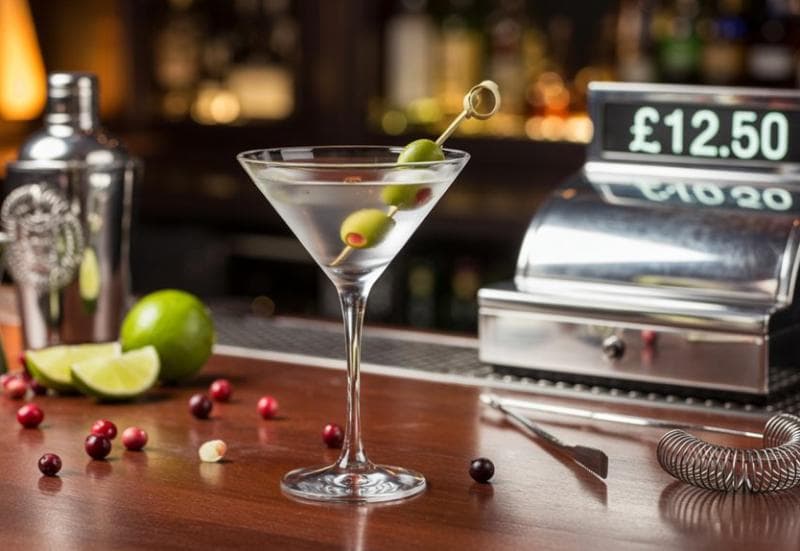
To maximize margin on Martinis, we review the cost of goods sold, focus on accurate pour costs (ideally 18%-24%), and adopt a strategic pricing approach that emphasizes profitability while maintaining customer appeal. We factor in all ingredients, including garnishes and glassware, and assess pricing frequently to adapt to market changes. Leveraging techniques like premium upsells and happy hour pricing can enhance volume and margins. Further exploration reveals additional strategies and insights into effective bar program management.
Key Takeaways
- Calculate ingredient costs, including garnishes and mixers, to determine the true cost per Martini.
- Ensure pour costs for Martinis remain between 18% and 24% for optimal pricing.
- Regularly review and adjust ingredient costs to maintain profitability margins.
- Employ strategic pricing to balance volume sales and profitability, especially during happy hours.
- Train staff to upsell premium options by using enticing descriptions and strategically placing them on the menu.
Calculating the Cost of Goods Sold for Martinis
Calculating the cost of goods sold (COGS) for martinis is essential to guarantee our bar program remains profitable.
We begin by evaluating the ingredient costs, including gin or vodka, vermouth, and garnishes. To find the cost per drink, we measure the total ingredient costs and divide by the number of servings. For instance, if our ingredient costs total $3.00 and we aim for a pour cost of 20%, our cocktail pricing suggests a selling price of $ 12.00.
It's essential to track these ingredient costs consistently, as they can fluctuate, which can impact our profit margins. By including all components, such as mixers and glassware, in the CGS calculation, we ensure accurate pricing and maintain the desired profit margins for our martini offerings.
Understanding Pour Costs and Their Impact on Pricing
When it comes to running a successful bar program, understanding pour costs is vital for setting accurate and profitable pricing.
Cost is a significant component of any pricing strategy. For instance, a Martini with a cocktail cost of $4 should be priced between $16.67 and $22.22 to keep the pour cost within the ideal 18% to 24% range. This guarantees we're crafting profitable cocktails while offering fair drink prices.
Pour cost is crucial; price a $4 Martini at $16.67-$22.22 to maintain an 18%-24% pour cost.
We must consider the total cost, including garnishes, mixers, and glassware, in our calculations. Accurate pour sizes are essential, as the 5 ½ ounces of spirits are the most significant expense.
Regularly reviewing ingredient costs allows us to adjust and maintain desired profit margins despite market fluctuations.
Strategies for Premium Upsells and Customer Engagement
Let's explore how mastering upsell techniques can transform our bar program into a more profitable venture.
By engaging customers with tailored bar experiences and offering high-profit drink suggestions, we can enhance their interaction with our offerings while boosting our bottom line.
With strategic menu placement, enticing descriptions, and well-trained staff, our premium options will stand out, encouraging patrons to indulge in high-quality selections.
Upsell Techniques Mastery
Although it's tempting to stick with tried-and-true sales tactics, mastering upsell techniques can transform a bar program's profitability and customer engagement. By offering premium spirits in our cocktail recommendations, we can subtly enhance perceived quality, encouraging patrons to indulge.
Charm pricing, like setting a Martini at $12.99 instead of $13, can influence buying decisions, making upsells feel more approachable. Highlighting high-profit cocktails with enticing descriptions on the menu can naturally draw attention, increasing their appeal.
Pricing your drinks strategically and training staff to suggest premium options can greatly boost our margins. Additionally, limited-time specials featuring exclusive ingredients create a sense of urgency, prompting customers to explore premium choices.
Engaging Bar Experiences
Creating engaging bar experiences is essential for driving premium upsells and enhancing customer engagement. By introducing premium upsells, such as top-shelf liquors and unique garnishes, we can intentionally increase drink costs, thereby boosting profit margins while offering a memorable experience.
Interactive cocktail experiences—think build-your-own martini stations—encourage customers to spend more and foster loyalty. Our cocktail menu should feature limited-time specials, creating a sense of urgency and enticing customers with exclusive options.
Training our staff to recommend high-margin cocktails and upsell complementary items, such as appetizers, further increases the average check size. Highlighting signature cocktails with enticing descriptions on the menu can psychologically influence customers to choose pricier options.
These pricing strategies not only enhance customer satisfaction but also effectively drive sales of premium drinks.
High-Profit Drink Suggestions
As we refine our approach to creating enchanting bar experiences, focusing on high-profit drink suggestions can further elevate our program's success. Offering premium upsells, such as craft spirits or high-end mixers for cocktails, can considerably boost profit margins. Featuring signature martinis with intriguing descriptions on the menu encourages customers to opt for higher-margin options. Let's consider some strategies:
Here are some strategies and their benefits:
- Craft Spirits - Increase profit through pricing
- Enticing Descriptions - Drive high-margin drink choices
- Staff Training - Enhance upselling skills
- Bundling with Snacks - Boost overall sales
Implementing staff training on upselling enhances bartender engagement and customer interactions. Bundling martinis with appetizers creates perceived value, while limited-time promotions or seasonal specials drive urgency and foot traffic, maximizing profitability.
Leveraging Happy Hour Pricing to Boost Sales Volume
Let's explore how we can effectively use happy hour pricing to boost sales volume and profitability.
By maximizing off-peak traffic with strategic discounts, we can attract larger crowds enthusiastic about discounted cocktails.
This increase in volume not only offsets the lower price but also encourages customers to return, supporting our overall operational costs.
Maximizing Off-Peak Traffic
While many bars struggle to fill seats during off-peak hours, implementing happy hour pricing can be a game-changer for boosting sales volume and increasing customer traffic.
By strategically adjusting our pricing, we can turn a slow afternoon into a bustling scene, maximizing revenue with each profitable drink served. Offering discounts on popular cocktails, such as Martinis, can attract larger crowds who are enthusiastic about good deals.
To make this work, consider these strategies:
-
Promote through social media: Create excitement and urgency around our happy hour.
-
Set attractive pricing: Guarantee that drinks are priced to cover costs while encouraging high volume.
-
Focus on popular drinks: Increase orders with customer favorites.
-
Enhance customer loyalty: Provide perceived value to encourage repeat visits.
-
Monitor sales trends: Adjust our bar program to optimize offerings.
Strategic Discount Offering
To effectively leverage happy hour pricing and boost sales volume, we must consider strategic discount offerings that draw in larger crowds. By reducing the price of a cocktail, particularly for signature Martinis, we implement a strategic discounting approach that serves as a loss leader. This encourages customers to explore other higher-margin drinks, thereby increasing profits.
When setting happy hour prices, it's essential to maintain a pour cost between 18% and 24% to guarantee a reasonable profit. Price adjustments should attract customers while maintaining profitability. Typically, bars experience a 20% to 30% rise in drink orders during these promotions.
This well-structured happy hour strategy not only enhances immediate sales but also fosters customer retention, encouraging patrons to return for more value-driven experiences.
Volume-Driven Profitability
Boosting sales volume through happy hour pricing hinges on our ability to craft compelling drink offers that not only attract new patrons but also encourage repeat visits.
By lowering pour costs on bar drinks, such as Martinis, during happy hour, we can employ volume-driven pricing strategies to boost profitability. This approach can lead to a significant increase in sales volume, as the discounted prices attract customers.
Here's how we can leverage this:
-
Strategically price cocktails to maximize order volume.
-
Encourage customer loyalty by providing perceived value.
-
Balance pricing strategies to maintain profitability.
-
Optimize for cost for greater margin control.
-
Utilize happy hour to enhance the bottom line.
Balancing Operational Costs With Competitive Pricing
Achieving the right balance between operational costs and competitive pricing in our bar program requires careful strategy and ongoing attention.
As bar managers, we aim to maintain a pour cost of 20% to 24% for our Martinis to guarantee profitability while still appealing to customers. This involves factoring in the 5 ½ ounces of liquor each Martini contains, which greatly impacts our ingredient costs.
By focusing on volume sales—given that Martinis make up 350 of our 500 nightly drink orders—we can effectively manage our pricing strategy. Regularly reviewing ingredient costs and seasonal fluctuations is essential to adapt our pricing as needed.
Effective inventory management helps us mitigate hidden costs, such as waste and spillage, ensuring competitive pricing and maximizing our margins.
Optimizing Your Bar Program for Maximum Profitability
How can we guarantee our bar program reaches its maximum profitability potential? We need to focus on maintaining an ideal pour cost between 18% and 24% when pricing each cocktail. This ensures that our prices accurately reflect ingredient costs while maximizing our profit.
Regular analysis and adjustment of cocktail pricing can keep us competitive and cover operational expenses. Utilizing inventory management software enables us to track ingredient usage and minimize waste, thereby reducing our cost of goods sold.
Menu engineering positions high-margin drinks prominently, enticing customers with descriptive options to choose profitable choices. Additionally, introducing loyalty programs and seasonal promotions boosts perceived value and enhances revenue throughout the year.
-
Target for the cost of 18%-24%
-
Adjust cocktail prices regularly
-
Use inventory management software
-
Enhance menu engineering
-
Introduce loyalty programs and promotions
Conclusion
In maximizing our bar program's profitability, we've explored the essential steps: calculating the cost of goods sold for martinis and understanding pour costs. We've also discussed premium upsells and customer engagement strategies, leveraging happy hour pricing, and balancing operational costs with competitive pricing . By focusing on these areas, we can refine our pricing strategies to increase sales volume and ensure a healthy profit margin, ultimately enhancing our overall business success. Let's implement these strategies for ideal results.