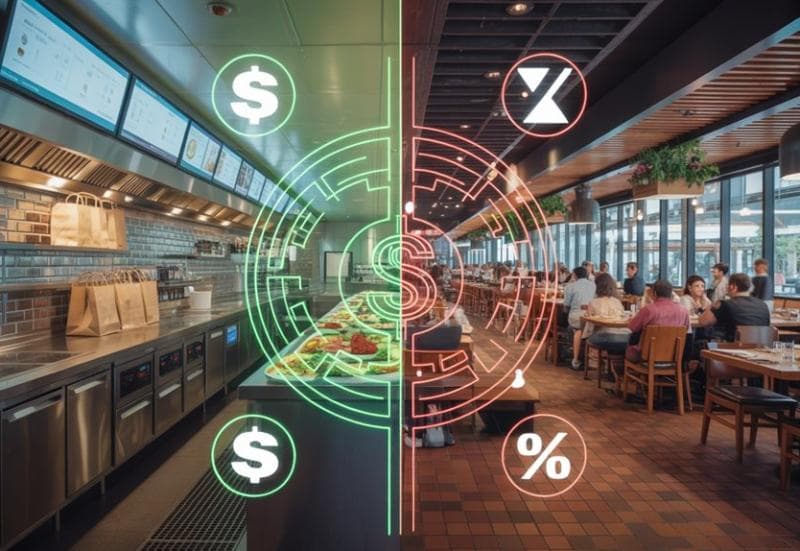
When choosing between ghost kitchens or dine-in expansion for off-premise menus, consider that ghost kitchens reduce overhead and staffing, hitting a break-even point at $650,000 in sales. They allow for flexible pricing models, such as revenue sharing, which benefits new brands. Dine-in expansion requires higher leasing and staffing costs, as well as necessary infrastructure investments. Profitability in ghost kitchens hinges on delivery fees and local demand. Optimizing these elements can enhance customer satisfaction and success in off-premise dining. Explore further for more insights.
Key Takeaways
- Ghost kitchens have lower upfront costs and a break-even point of $650,000 in annual sales, making them an attractive option for new ventures.
- Revenue-sharing models in ghost kitchens can minimize risks for new brands, while established operators might prefer fixed fees for cost stability.
- Dine-in expansion necessitates substantial investments in leasing, staffing, and regulatory compliance, which in turn impact overall operational costs and pricing strategies.
- Strategic placement of ghost kitchens near demand areas reduces delivery costs, enhancing pricing competitiveness for off-premise menus.
- Menu strategies should align with local preferences to maximize sales and repeat orders, which is crucial for meeting financial goals in ghost kitchens.
Understanding Ghost Kitchen Pricing Models
When we explore ghost kitchen pricing models, it becomes apparent that they offer a distinct advantage for new culinary ventures. The ghost kitchen model enables us to minimize upfront costs, requiring annual sales of at least $650,000 to achieve break-even.
By adopting effective pricing strategies, virtual restaurants can capitalize on reduced overhead and staffing expenses, often just 25% of a traditional restaurant's staff. Fixed fees or revenue percentages make this model comparable to renting a smaller space, optimizing our financial flexibility.
Moreover, understanding our delivery radius is essential. We must align menu prices with delivery costs, ensuring food quality remains high.
Evaluating Dine-In Expansion Costs
When considering a dine-in expansion, we must carefully evaluate the various costs associated with it. Leasing expenses can be significant, especially in high-rent areas compared to ghost kitchens. Operational costs increase with the addition of staff and new sanitation regulations, negatively impacting revenue. Overhead costs, such as utilities and maintenance, add to the burden. Investing in kitchen technology and efficient order management systems is crucial for controlling these expenses and enhancing profitability.
Here's a breakdown of potential cost factors and impacts:
Leasing Expenses: Higher in densely populated areas
Operational Costs: Staff and compliance with regulations
Overhead Costs: Utilities and maintenance
Technology Investments: Essential for Efficiency
For a successful dine-in expansion, we need to balance these costs against potential revenue, aiming for annual sales of at least $650,000 to break even.
Fixed Fees vs. Revenue Percentage Models
Choosing between fixed fees and revenue percentage models for ghost kitchens involves understanding the core differences and how they align with our business goals.
Fixed fees offer predictability, allowing us to budget effectively. We understand exactly what we’ll pay each month, which helps us manage our finances effectively.
Conversely, revenue percentage models tie the ghost kitchen's earnings to our sales performance. This can encourage better service, as the kitchen benefits directly from our success.
For restaurant owners, selecting the right model depends on factors like anticipated order volume and financial implications. If we're a new brand, revenue-sharing could minimize initial risks, while established operators might prefer fixed fees for cost stability.
Ultimately, aligning our choice with projected sales and operational efficiency is essential.
Infrastructure Investments for Dine-In Expansion
Expanding our dine-in infrastructure requires strategic investments to support our evolving business model.
As we consider infrastructure investments, it's essential to adapt our kitchen spaces for enhanced off-premise dining. This means guaranteeing efficiency to meet the increased delivery demand that emerged after the pandemic.
New regulations require additional equipment and staff, which can significantly impact our operational costs. By modifying space for dedicated prep areas, we minimize cross-contamination and enhance service speed, boosting customer satisfaction.
Adapting our infrastructure with dedicated prep areas minimizes cross-contamination and boosts service speed, enhancing customer satisfaction.
Incorporating technology, such as order management systems, helps us balance dine-in and delivery services, responding to consumer preferences for convenience and quality.
Finally, investing in packaging assures that our off-premise menu items maintain their integrity during transport, meeting customer expectations and supporting a seamless dining experience.
Overhead Cost Reductions in Ghost Kitchens
As we explore ideal strategies for our business, ghost kitchens present a significant opportunity to reduce overhead costs substantially.
In the restaurant industry, ghost kitchens operate by eliminating the need for front-of-house staff and dining spaces, instead focusing on food preparation and delivery. Operating in lower-rent industrial areas, they achieve rental savings up to 50% compared to traditional spots.
Shared kitchen spaces further cut startup costs, allowing multiple brands to share resources and reduce ingredient expenses.
With streamlined staffing, we need only about 25% of the workforce of full-service restaurants. By leveraging technology for order management and delivery apps, we enhance efficiency and minimize manual labor.
This approach not only reduces our labor costs but also optimizes the overall operational process.
Menu Adaptability for Off-Premise Dining
How can we guarantee our off-premise dining menu remains both appealing and practical for delivery? We must carefully select menu items that travel well, ensuring they maintain flavor and texture during food delivery.
By focusing on quality food, virtual brands can thrive by offering dishes that not only taste great but also look appealing upon arrival. Packaging plays an essential role here; it should preserve both the integrity and the visual appeal of our offerings.
Quality food and appealing packaging ensure virtual brands deliver dishes that satisfy both taste and presentation.
Utilizing data analytics allows us to identify popular items and adjust our menu to align with consumer preferences and market trends. Additionally, a balance of core offerings and limited-time specials keeps our menu fresh.
Engaging customers through social media can further enhance visibility and drive demand.
Delivery Logistics and Their Impact on Pricing
When considering delivery logistics, optimizing delivery routes and managing delivery costs become crucial components of our pricing strategy.
By streamlining routes and partnering with efficient delivery services, we can reduce costs and ensure that food arrives quickly and in optimal condition.
These efforts not only help us maintain competitive pricing but also protect our profit margins in the highly competitive ghost kitchen market.
Optimizing Delivery Routes
Efficient delivery route optimization is key to the success of ghost kitchens. By focusing on optimizing delivery routes, we can substantially enhance delivery efficiency and positively impact our pricing models. Here’s how:
-
Reduce Costs and Time: Studies show that efficient routing can cut fuel consumption by up to 20%, minimizing delivery times and costs. This directly benefits our bottom line.
-
Boost Delivery Success: Leveraging advanced routing software helps calculate the fastest routes using real-time traffic data, resulting in a 30% increase in delivery success rates.
-
Increase Profitability: Multi-stop routing enables us to consolidate orders into a single trip, thereby reducing costs per order and enhancing overall profitability.
Managing Delivery Costs
As we explore managing delivery costs, understanding the intricate relationship between delivery logistics and pricing is essential for ghost kitchen operators.
Delivery costs significantly impact our pricing strategies, especially when partnerships with delivery platforms result in 15% to 30% of each order being deducted. To maintain profitability, ghost kitchens must achieve annual sales of at least $650,000 to break even.
Strategically placing ghost kitchens near high-demand areas can reduce delivery times and costs, enhancing customer satisfaction.
Utilizing efficient order management systems, such as Deliverect, helps streamline operations by aggregating orders, minimizing errors, and controlling costs.
Additionally, investing in quality packaging ensures that food arrives intact, thereby reducing the need for refunds.
Assessing Local Demand for Off-Premise Options
To effectively assess local demand for off-premise dining options, we must first analyze market trends that indicate consumer preferences for delivery and takeout services.
Understanding these patterns helps us evaluate the potential demand for delivery in specific areas and determine if a ghost kitchen or expanded dine-in service would be more beneficial.
Analyzing Market Trends
While evaluating local demand for off-premise options, it's vital to understand how consumer preferences have evolved, especially in the wake of the pandemic.
Market demand analysis highlights several key factors:
-
Ghost kitchen concept: As these kitchens operate without consumer awareness of their origins, transparency in branding is important to attract and retain local customers.
-
Food delivery: With a significant shift towards delivery, adapting menus to suit delivery logistics can enhance customer satisfaction and restaurant adaptability.
-
Adaptation to market conditions: With 80% of diners modifying menus due to shortages, understanding local preferences and availability is fundamental for success.
Evaluating Delivery Demand
Understanding the current landscape of delivery demand is essential for evaluating local interest in off-premise dining options. With the rise of ghost kitchens, fueled by increased consumer demand, a thorough market analysis becomes significant.
We must consider that 51% of adults still enjoy in-person dining but seek the convenience of delivery services. The shift in 2020, where restaurant sales dropped by $240 billion, pushed many to adopt delivery and takeout models.
To succeed, ghost kitchens require annual sales of at least $650,000 to break even. Competition has driven up marketing costs, making it important to assess local delivery demand effectively.
Additionally, 72% of adults prefer food from visible locations, indicating that transparency and brand awareness are key in capturing interest.
Profitability Considerations in Ghost Kitchens
Ghost kitchens offer a compelling business model for those seeking efficiency and reduced overhead costs; however, achieving profitability requires careful consideration of several key factors.
Efficiency and reduced overheads make ghost kitchens appealing, but profitability demands strategic planning.
To guarantee success, we must focus on:
-
Delivery Fees: These can eat into our profits, so negotiating competitive rates or offering enticing in-house delivery options could be beneficial.
-
Menu Strategies: Crafting a menu that aligns with local preferences and trends is essential. It not only maximizes sales but also encourages repeat orders, which is critical for meeting the $650,000 break-even point.
-
Financial Planning: High leasing and marketing expenses demand meticulous budgeting.
Quality Assurance in Delivery-Only Models
Guaranteeing quality assurance in delivery-only models requires a keen focus on several vital elements.
First, let's consider the presentation of food. Over 70% of customers consider packaging quality and visual appeal when selecting delivery options. Sturdy, well-designed containers are essential. They prevent leaks, maintain temperature, and keep items separate, all of which enhance the dining experience.
Next, operational efficiency is important. By streamlining workflows and utilizing dedicated preparation spaces, we minimize cross-contamination risks and enhance service speed.
Additionally, regularly evaluating and adapting menu items for delivery guarantees they meet the high standards customers expect. These steps not only maintain food integrity but also strengthen the overall customer experience in delivery-only models.
Let's prioritize these elements to secure success.
Customer Satisfaction in Off-Premise Dining
In the off-premise dining domain, ensuring order accuracy and a seamless delivery experience is crucial for customer satisfaction.
We must prioritize clear communication with our customers and leverage technology to manage orders efficiently, reducing errors that can lead to dissatisfaction.
Additionally, streamlining the delivery process with reliable partners and real-time tracking can enhance the customer experience by providing transparency and building trust.
Enhancing Order Accuracy
While ensuring order accuracy is a significant challenge in off-premise dining, addressing it can greatly enhance customer satisfaction and loyalty.
With 60% of customers dissatisfied due to incorrect orders, we must prioritize precision in food delivery. Implementing centralized digital platforms can help improve order accuracy by 30%.
Here are three strategies to contemplate:
-
Technology Integration: Use order management systems to minimize errors in off-premise dining.
-
Effective Labeling: Clear packaging with content and dietary information can prevent mix-ups, with 75% of consumers preferring this approach.
-
Staff Training: Regular training on order fulfillment can reduce mistakes by 25%, highlighting the importance of employee engagement.
These steps will help us create a seamless and reliable food delivery experience.
Streamlining Delivery Experience
After enhancing order accuracy, we shift our focus to streamlining the delivery experience, a key factor in boosting customer satisfaction in off-premise dining.
We recognize that 72% of adults prefer ordering from visible locations, making transparency in ghost kitchen operations essential. Quality packaging plays a crucial role; sturdy containers prevent leaks and maintain food integrity, thereby ensuring a positive customer perception.
Efficient order management systems, such as Deliverect, streamline delivery by reducing manual errors and syncing orders directly to POS systems.
Additionally, menu adaptability is important. We must continually innovate based on local cuisine trends to meet our customers' preferences.
Engaging with customers through social media and digital marketing also enhances satisfaction, ensuring our ghost kitchens remain top of mind.
Competitive Strategies in the Food Service Industry
Everyone recognizes the fast-paced evolution of the food service industry, where competitive strategies must adapt to changing consumer preferences and technological advancements.
Ghost kitchens thrive by leveraging delivery-only services and reducing the need for physical dining spaces. This model enables us to keep operating costs 40-60% lower than those of traditional restaurants, allowing for more competitive pricing on off-premise menus.
Successful ghost kitchens leverage effective digital marketing strategies to establish a robust online presence. To capture the market, we focus on:
-
Efficient Delivery Radius: A 2-3 mile range guarantees quick service and quality retention.
-
Menu Simplification: Offering high-demand items tailored for delivery enhances customer satisfaction.
-
Scalability: Low investment costs promote expansion in competitive markets.
These strategies position us favorably in relation to established competitors.
Conclusion
In summary, when deciding between ghost kitchens and dine-in expansion, we must weigh costs, pricing models, and customer satisfaction. Ghost kitchens offer reduced overhead and flexible pricing, appealing for delivery-focused strategies. Conversely, dine-in expansions require substantial infrastructure investments but can significantly enhance the customer experience. Both require careful consideration of quality assurance and competitive positioning to guarantee profitability. Ultimately, aligning our approach with business goals and market demands is key to thriving in the evolving food service landscape.