Menu pricing is essential for protecting our margins in the restaurant business. By collaborating with chefs, marketing teams, and operations, we develop pricing strategies that strike a balance between food costs and customer expectations. Utilizing techniques such as menu engineering and pricing psychology, we can effectively highlight high-margin items and boost sales. Technology helps us adapt pricing in real-time, ensuring competitive rates and optimized profits. For those interested, there’s much more to uncover about effective menu pricing strategies.
Key Takeaways
- Implement cost-plus pricing to ensure menu prices cover food, labor, and overhead expenses.
- Utilize menu engineering techniques to highlight and promote high-margin items effectively.
- Regularly review and adjust prices in response to fluctuating ingredient costs and market trends.
- Collaborate with kitchen and marketing teams for data-driven pricing strategies aligned with brand value.
- Leverage technology for dynamic pricing adjustments and real-time sales data analysis.
Understanding the Importance of Menu Pricing
Why is menu pricing so vital for restaurants? It’s the backbone of our revenue, guaranteeing we cover food costs, labor, and rent while maintaining healthy profit margins.
Menu pricing directly affects customer perception; prices that reflect quality and value encourage customer loyalty. We must adopt effective pricing strategies, like cost-plus and value-based pricing, to align with our financial goals and what customers are willing to pay.
Prices reflecting quality and value boost customer loyalty, crucial for financial goals and customer satisfaction.
Regularly reviewing prices is essential, particularly in light of fluctuating ingredient costs and a competitive landscape.
By understanding food cost percentages, typically ranging from 28% to 35%, we can set prices that support our desired gross profit margin. This cost management guarantees we remain profitable and adaptable in a dynamic market.
Let's plate it right with smart pricing!
Key Stakeholders in Pricing Decisions
When considering menu pricing strategies, it’s crucial to take into account the roles of various stakeholders.
Restaurant owners and managers set the financial tone, while chefs and kitchen staff influence pricing through their control over portion sizes and ingredient selection.
Meanwhile, the marketing and operations teams work together to guarantee the menu communicates perceived value to our customers, making collaboration among these groups key to successful pricing decisions.
Role of Restaurant Owners
Restaurant owners play a crucial role in shaping the financial strategy of their establishments, setting menu prices that align with their profit goals and market positioning.
We must carefully consider menu pricing strategies, taking into account food costs, operational expenses, and competitor pricing. By analyzing sales data, we can identify high-profit items and adjust pricing strategies to maximize profit margins.
Understanding the perceived value of our offerings is crucial, as it enables us to set prices that resonate with our customers while covering our expenses. Monitoring market competition and customer demographics guarantees our menu remains competitive.
Regular reviews of menu prices, ideally conducted quarterly or biannually, enable us to adapt to changing ingredient costs and market trends, thereby securing our restaurant's sustained financial success.
Influence of Kitchen Staff
In the dynamic environment of restaurant operations, kitchen staff play a pivotal role in determining effective menu pricing. They influence the process through various aspects:
Ingredient Selection: Chefs strategically choose seasonal and cost-effective ingredients, which directly impact food costs and enable competitive pricing without compromising quality.
Portion Control: Maintaining consistent portion sizes guarantees profitability by aligning actual ingredient costs with menu pricing strategies.
POS Data Analysis: Collaborating with management, kitchen staff use this data to identify high-margin items and adjust prices for less profitable dishes.
Training and Awareness: Educating staff on food costs and profitability empowers them to make decisions that support the restaurant's financial goals.
Together, these efforts guarantee that menu pricing strategies are effective, optimizing both quality and profitability.
Marketing Team Collaboration
Effective menu pricing depends heavily on the collaborative efforts of various teams within a restaurant, including the kitchen and marketing teams.
Marketing team collaboration is essential in shaping pricing strategies that align with our restaurant's brand and customer value perception. By leveraging competitive analysis, they ensure our menu prices are both attractive and distinct from those of our competitors.
This collaboration also extends to understanding customer demographics and preferences, helping us tailor pricing strategies to our target audience. Marketing teams utilize data-driven insights, such as customer feedback and sales trends, to dynamically adjust pricing strategies.
They work closely with operations to highlight high-margin items through strategic promotions and menu design. Together, these efforts guarantee our restaurant menu items remain profitable while enhancing the customer experience.
Factors Influencing Menu Pricing
When setting menu prices, various factors come into play that greatly impact our decisions.
Let's break it down:
Food Cost Percentages: Accurate analysis of ingredient costs is crucial for maintaining profitability and setting prices that cover these expenses.
Labor and Overhead Costs: Incorporating labor and overhead expenses, such as rent and utilities, ensures that we cover all operational costs while achieving the desired profit margins.
Market Competition and Customer Expectations: We must strike a balance between competitive pricing and customer expectations, focusing on perceived value and unique offerings rather than merely matching competitor prices.
Customer Demographics and Brand Positioning: Understanding our target audience's spending habits helps inform pricing decisions, while brand positioning dictates the acceptable price levels, whether high-end or casual.
Exploring Core Pricing Methods
Let's explore two fundamental pricing methods: the Cost-Plus approach and Value-Based Pricing.
The Cost-Plus method is straightforward, where we calculate the total cost of a dish and add a percentage markup to guarantee profitability.
In contrast, Value-Based Pricing allows us to set prices based on the perceived value of a dish, which can lead to higher prices if customers see the quality or uniqueness as worth the extra cost.
Cost-Plus Approach Essentials
Understanding the essentials of the Cost-Plus Approach can significantly impact a restaurant's pricing strategy, ensuring that menu items are both profitable and competitively priced.
Let's explore the vital steps:
Calculate Total Costs: Add up food ingredient costs, labor, and overhead. This is the foundation of the restaurant's pricing based on actual costs.
Set Desired Profit Margin: Decide how much profit is needed to meet business goals and add it to the total cost. This makes certain prices profitable.
Monitor Pricing Changes: Regularly review ingredient costs and market demands to adjust prices, maintaining competitiveness without sacrificing profit.
Consider Customer Preferences: While this method focuses on costs, we must remain aware of customer willingness to pay to avoid pricing too high and losing sales.
Value-Based Pricing Insights
While the Cost-Plus Approach ensures that menu items cover their costs and generate a profit, we can explore an alternative strategy that goes beyond simply covering expenses.
Value-based pricing focuses on customer perception, allowing us to set prices based on what patrons are willing to pay for unique or high-quality dishes. This menu pricing strategy can enhance profit margins by aligning prices with perceived value rather than just ingredient costs.
By analyzing sales data, we identify items that resonate most with customers and adjust prices to reflect their willingness to pay. Enhancing the dining experience can justify higher prices and foster a perception of quality.
This approach offers pricing flexibility, enabling adjustments based on market demand and the competitive landscape, ultimately boosting customer loyalty.
Calculating Food Costs and Break-Even Points
Calculating food costs and break-even points is essential for managing a successful restaurant menu.
We need to set menu prices that guarantee profitability by understanding several key factors:
Calculating Food Costs: Determine the total ingredient cost for each dish. This helps in setting competitive and profitable menu prices.
Food Cost Percentage: Use the formula
(Plate Cost / Selling Price) × 100. Aim for a food cost percentage of 25% to 40% for entrees.Break-Even Point: Calculate this by dividing total fixed costs by the difference between the selling price and the variable cost per dish. It tells us how many dishes we need to sell to cover costs.
Profit Margins: Maintain a gross profit margin of around 70% by adapting to ingredient cost fluctuations and market trends.
Analyzing Menu Item Profitability
To ensure our menu remains profitable, we must look beyond simply calculating costs and break-even points. Our Restaurant Menu Pricing Strategy involves using menu engineering to analyze the profitability of menu items. By leveraging POS systems, we identify high-profit items and make strategic adjustments based on sales data. Calculating the food cost percentage helps us see if items are priced right. Regular profitability analysis enables us to adjust to changing ingredient costs and market trends.
Profitability Factors, Action & Purpose:
- High-Profit Items: Promote & Optimize - Increase visibility and sales
- Sales Data: Analyze & Adjust - Ascertain pricing aligns with demand
- Customer Purchasing Behavior: Understand & Adapt - Enhance menu layout for profitability
Understanding customer purchasing behavior helps optimize menu placement for maximum engagement.
Leveraging Menu Engineering Techniques
Let's explore how strategic item placement can impact the success of our menu.
By leveraging the "Golden Triangle" and utilizing visual cues such as boxes and icons, we can direct our customers' attention to high-margin items and enhance their appeal.
Regularly updating and optimizing our menu layout guarantees we're always aligned with customer preferences and market trends, maximizing our revenue potential.
Strategic Item Placement
When considering menu design, strategic item placement plays a crucial role in guiding customer choices and driving sales. By focusing on the 'Golden Triangle' (top right), we can increase the visibility of high-margin items, encouraging customers to choose these first.
Here’s how we can optimize our menu:
Strategic Item Placement: Position high-margin items in the Golden Triangle to maximize attention and sales.
Use Visual Cues: Highlight profitable dishes with boxes or bold fonts to draw customer focus.
Optimize Menu Layout: Limit the number of items per category to seven to reduce choice overload and facilitate decision-making.
Bundle Complementary Items: Group items to enhance perceived value and increase the average check size.
Analyzing sales data helps refine these pricing strategies, ensuring our menu effectively meets performance goals.
Visual Cues Utilization
Building on strategic item placement, we can further enhance the effectiveness of our menu by leveraging visual cues.
Menu engineering enables us to utilize icons, boxes, and highlighted text, drawing attention to high-margin items and enhancing their perceived value. By implementing these visual elements, we can guide customer purchasing decisions more effectively.
Research indicates that such strategic design can lead to a sales increase of up to 30%. It's essential to consider choice overload; by limiting menu items in each category, we make decision-making easier for customers.
This approach not only simplifies their experience but also elevates the likelihood of choosing higher-margin dishes. Ultimately, these techniques guarantee our menu remains a powerful tool in driving profitability.
Optimal Menu Layout
To optimize menu layout effectively, we need to understand how customers interact with menus. By leveraging menu engineering techniques, we can strategically place high-margin items where they capture customer attention and boost sales volume. Here’s how:
Golden Triangle: Focus on the top right and center of the menu for our star dishes, enhancing perceived value and prompting customer choices.
Item Categorization: Use menu engineering to classify items as Stars, Plow Horses, Puzzles, or Dogs, guiding us on promoting or removing dishes.
Visual Cues: Boxes, icons, and enticing descriptions draw attention to high-margin items, influencing decision-making.
Limit Choices: Keep categories to around seven items to prevent overload, streamline decision-making, and enhance the overall dining experience.
Using Pricing Psychology to Enhance Sales
Although pricing might seem straightforward, applying psychological strategies can greatly enhance sales by tapping into consumer perceptions and behaviors.
We can leverage psychological pricing to set menu prices based on perceived value. Charm pricing, such as $9.99, makes items appear more affordable. Price anchoring, where we list higher-priced items first, helps lower-priced options seem more appealing.
The Golden Triangle in menu design positions high-margin items prominently, guiding customer choices. Decoy pricing introduces a higher-priced option to make mid-tier items more attractive. Limited-time offers create a sense of urgency, encouraging quick decisions.
Adapting Pricing Strategies With Real-Time Data
By leveraging real-time data, we can adjust our menu pricing strategies quickly in response to market changes and maintain profitability.
Real-time data analytics enables us to monitor ingredient costs and adjust prices in response to market fluctuations, thereby maintaining profits. Utilizing POS systems provides instant access to sales data, allowing for the identification of underperforming items that require reevaluation or price adjustments.
Additionally, tracking customer demand through real-time data enables the application of dynamic pricing, such as offering discounts during slower periods, to boost patronage without compromising margins.
Finally, technology that offers insights into labor costs ensures our menu pricing accounts for these expenses, thereby safeguarding profitability. Regular updates based on performance metrics keep us competitive and aligned with current customer preferences.
Harnessing Technology for Optimal Pricing Management
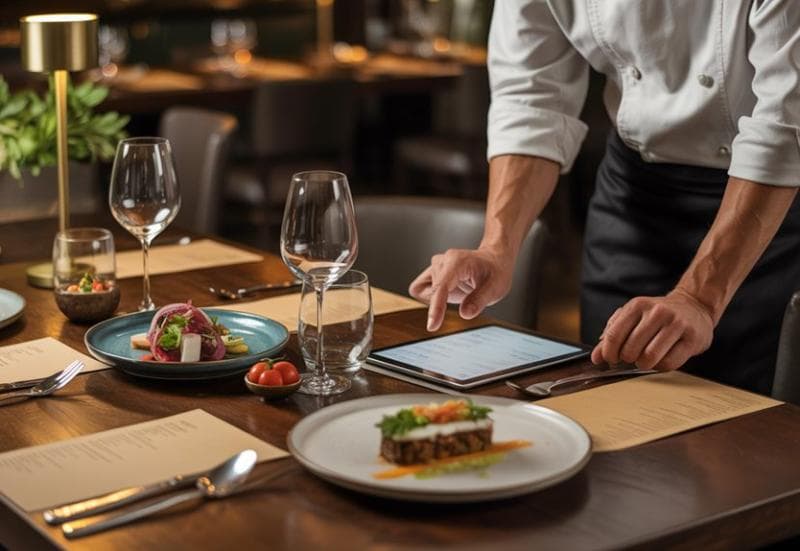
As we adapt our pricing strategies using real-time data, it’s crucial to harness technology for ideal pricing management. Implementing a restaurant point-of-sale (POS) system enables us to track sales, item performance, and customer preferences, ultimately leading to data-driven pricing decisions.
Digital menu management tools enable us to quickly adjust menu pricing in response to changing ingredient costs. In contrast, advanced inventory management provides accurate forecasts of supply needs, enabling proactive price adjustments.
Dynamic pricing models enable us to modify prices based on demand, time, or special events, maximizing revenue while aligning with customer preferences. CRM technology helps collect feedback and purchasing behavior data, refine our pricing strategies, and enhance perceived value.
Conclusion
In summary, menu pricing is vital for maintaining healthy profit margins. By understanding the various factors that influence pricing and involving key stakeholders in the decision-making process, we can develop effective strategies. Calculating food costs, determining break-even points, and applying menu engineering techniques further strengthen our approach. Additionally, incorporating pricing psychology and adapting to real-time data ensures that we remain competitive. Leveraging technology for pricing management helps us optimize our strategies, ultimately supporting sustainable business growth.